
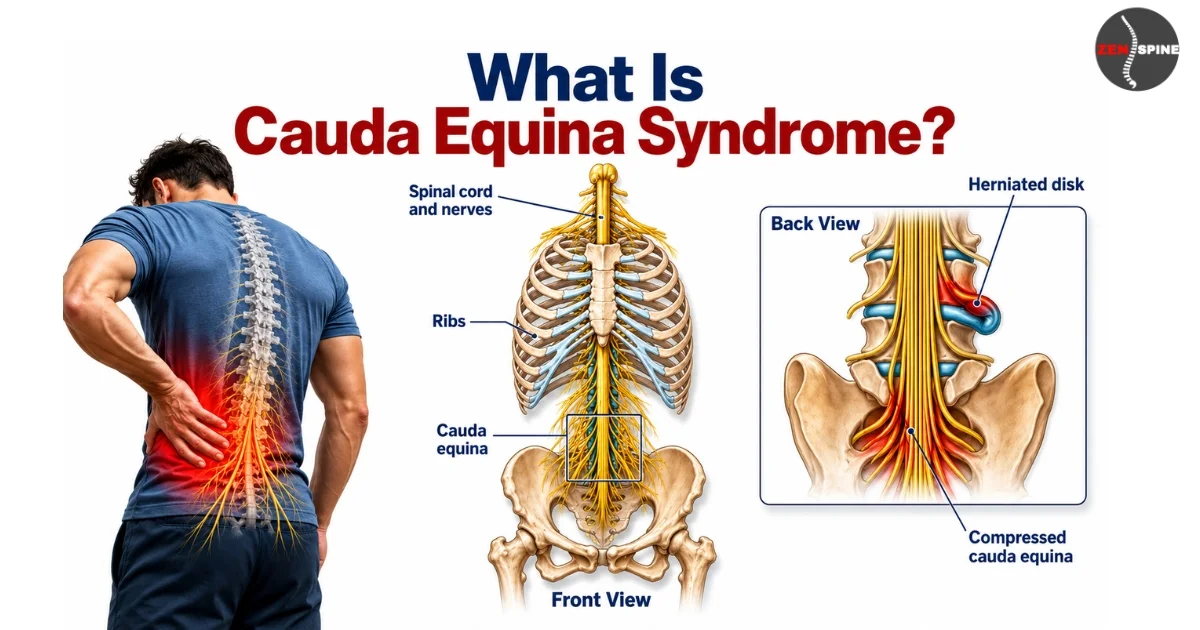
Cauda equina syndrome (CES) is a rare but serious condition caused by compression of the nerves at the lower end of the spinal cord. These nerves control important functions involving the legs, bladder, bowel, and sexual organs. Because significant nerve compression can lead to permanent problems, cauda equina syndrome requires urgent medical assessment and treatment.
Understanding the warning signs can help patients recognise when lower back pain or neurological symptoms need immediate attention.
What Is Cauda Equina Syndrome?
The cauda equina is a bundle of nerves located at the lower end of the spinal canal. These nerves carry signals between the brain, spinal cord and lower body.
Cauda equina syndrome occurs when these nerves become severely compressed. A large slipped disc is one of the more common causes, although spinal stenosis, tumours, infections, trauma and bleeding around the spine can also cause compression.
Unlike ordinary lower back pain, CES can affect bladder and bowel function, sensation around the groin and buttocks, and strength in the legs.
What Are the Symptoms of Cauda Equina Syndrome?
The symptoms can vary from person to person. However, some warning signs require particularly urgent attention.
Common symptoms include:
- Severe lower back pain
- Pain travelling down one or both legs
- Numbness or tingling in the legs
- Weakness in one or both legs
- Difficulty walking
- Numbness around the buttocks, inner thighs or genital area
- Difficulty starting or controlling urination
- Loss of bladder or bowel control
- Changes in sexual function
What Is Saddle Anaesthesia?
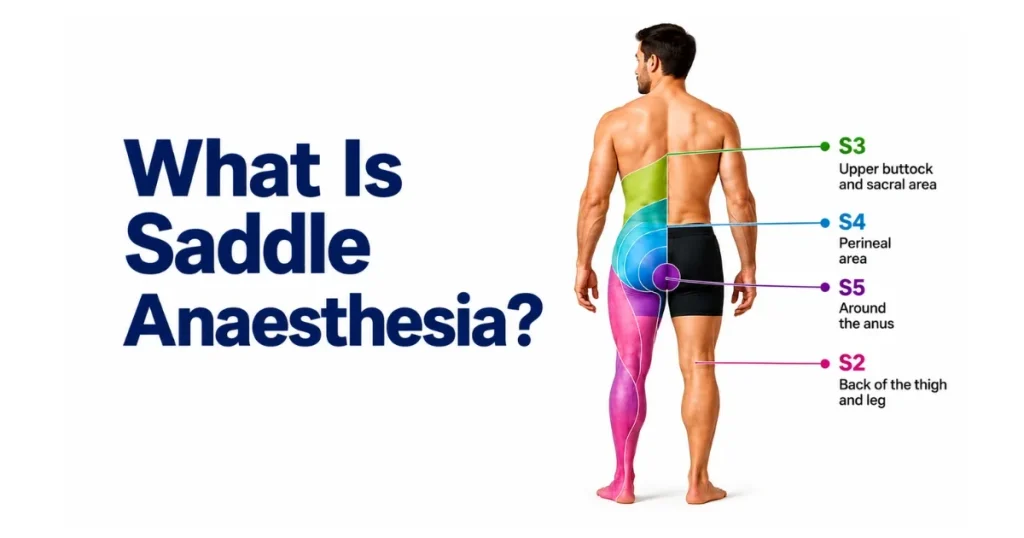
Saddle anaesthesia refers to reduced or lost sensation around the areas that would come into contact with a saddle, including the inner thighs, buttocks and genital region.
This is an important warning sign of possible cauda equina compression. If it develops alongside bladder, bowel or leg symptoms, urgent medical evaluation is essential.
What Causes Cauda Equina Syndrome?
Several conditions can put pressure on the cauda equina nerves. These include:
- A large lumbar disc herniation or slipped disc
- Narrowing of the spinal canal (spinal stenosis)
- Spinal tumours
- Spinal infections
- Severe spinal injuries or fractures
- Bleeding around the spinal nerves
A severe disc prolapse in the lower back can sometimes compress several nerves at once and produce symptoms of CES.
Is Cauda Equina Syndrome an Emergency?
Yes. Suspected cauda equina syndrome should be treated as a medical emergency.
New bladder or bowel problems, numbness around the saddle region, or significant and rapidly developing leg weakness should not be ignored or managed at home.
Early assessment allows doctors to determine whether the cauda equina nerves are being compressed and whether urgent treatment is necessary. Delaying assessment may increase the risk of lasting nerve damage.
If you develop these warning signs, seek urgent medical attention rather than waiting for routine treatment or a scheduled appointment.
How Is Cauda Equina Syndrome Diagnosed?
A doctor will usually begin with a detailed medical history and neurological examination. This may include assessing:
- Muscle strength
- Reflexes
- Sensation
- Walking ability
- Bladder and bowel symptoms
- Changes in sensation around the saddle region
An MRI scan is commonly used when cauda equina syndrome is suspected because it can help identify nerve compression and its underlying cause.
The urgency of investigation and treatment depends on the patient’s symptoms and clinical findings.
How Is Cauda Equina Syndrome Treated?
Treatment depends on what is causing the nerve compression and how severe the symptoms are.
When significant acute compression is confirmed, urgent surgical decompression may be required to relieve pressure on the affected nerves. Depending on the cause, this could involve procedures such as removing a portion of a herniated disc or creating more space around the compressed nerves.
Other causes, such as infection or a tumour, require condition-specific treatment.
After treatment, some patients may require rehabilitation, physiotherapy, and ongoing monitoring of neurological, bladder, or bowel function.
Cauda Equina Syndrome vs Lower Back Pain
Most people with lower back pain do not have cauda equina syndrome. Lower back pain can result from muscle strain, disc problems, arthritis, and many other conditions.
However, new neurological symptoms should not be overlooked. If lower back pain is accompanied by progressive leg weakness, saddle numbness, or changes in bladder or bowel control, an urgent medical assessment is important.
A lower back pain specialist can assess the underlying cause of persistent or severe back symptoms and recommend appropriate investigations when necessary.
When Should You See a Spine Specialist?
You should seek medical advice if you experience persistent lower back pain, recurring leg pain, numbness, weakness, or symptoms that are affecting your daily activities.
However, symptoms such as new difficulty passing urine, loss of bladder or bowel control, saddle anesthesia, or rapidly worsening leg weakness require urgent medical attention.
At Zen Spine, patients can seek specialist assessment for a range of spinal and lower back conditions. Dr. Rakesh Dhake can evaluate symptoms, identify potential spinal causes, and advise on appropriate treatment based on the individual patient’s condition.
It is important to remember that not every case of back pain indicates a serious spinal disorder. A proper clinical assessment is the best way to understand the cause.
Frequently Asked Questions
Q1. What is the main warning sign of cauda equina syndrome?
Answer: Bladder or bowel dysfunction, saddle numbness, and significant leg weakness are among the most concerning symptoms, particularly when they occur with severe lower back or leg pain.
Q2. Can a slipped disc cause cauda equina syndrome?
Answer: Yes. A large lumbar disc herniation can compress the bundle of nerves forming the cauda equina and may cause CES.
Q3. Does cauda equina syndrome always require surgery?
Answer: Not every situation is identical. Treatment depends on the underlying cause and clinical findings. When acute, significant nerve compression is confirmed, urgent surgical decompression may be necessary.
Q4. Can cauda equina syndrome cause permanent nerve damage?
Answer: Yes. Severe or prolonged compression of the cauda equina nerves can potentially result in lasting problems involving the legs, bladder, bowel or sexual function. This is why suspected CES requires urgent assessment.
Q5. Is cauda equina syndrome the same as sciatica?
Answer: No. Sciatica commonly causes pain, tingling, or numbness along the path of the sciatic nerve. Cauda equina syndrome involves compression of multiple nerves and can cause additional red-flag symptoms such as saddle numbness and bladder or bowel dysfunction.