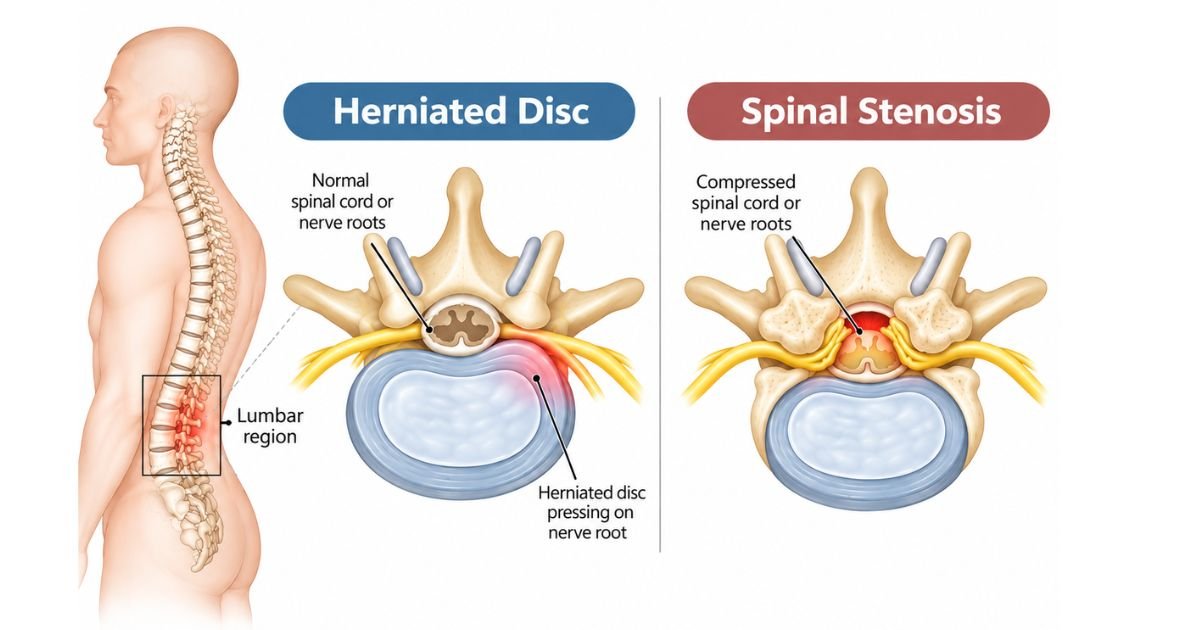
Back pain, leg pain, numbness and tingling can occur with several spinal conditions. Two terms that patients commonly see on MRI reports are herniated disc and spinal stenosis. Although both can affect nearby nerves and cause similar symptoms, they are not the same condition.
A herniated disc occurs when part of an intervertebral disc extends beyond its normal boundary and may irritate or compress a nearby nerve. Spinal stenosis refers to narrowing of a space within the spine, such as the spinal canal or the openings through which nerves pass.
Understanding the difference can help you better understand an MRI report, but symptoms alone cannot confirm which condition is causing your problem.
Herniated Disc vs Spinal Stenosis: What Is the Difference?
The main difference is what is happening anatomically.
With a herniated disc, the problem originates in the intervertebral disc. If the displaced disc material irritates or compresses a nerve root, it can cause pain, numbness, tingling or weakness in the area supplied by that nerve.
With spinal stenosis, the problem is reduced space around the spinal cord or nerves. Narrowing can develop because of age-related changes involving the discs, facet joints, ligaments and other spinal structures.
Both conditions can occur in the lower back or neck, and a person can have both a herniated disc and spinal stenosis at the same time.
Quick Comparison
| Feature | Herniated Disc | Spinal Stenosis |
| Main problem | Disc material extends beyond its normal boundary | Narrowing of a spinal canal or neural passage |
| Nerve involvement | May irritate or compress a nerve root | Narrowing may compress or affect neural structures |
| Common symptoms | Back pain, radiating pain, numbness, tingling or weakness | Back or leg symptoms, numbness, tingling or weakness |
| Walking-related symptoms | Variable | Can be prominent in lumbar stenosis |
| Sciatica | Can occur | Can also occur |
| Can both occur together? | Yes | Yes |
What Is a Herniated Disc?
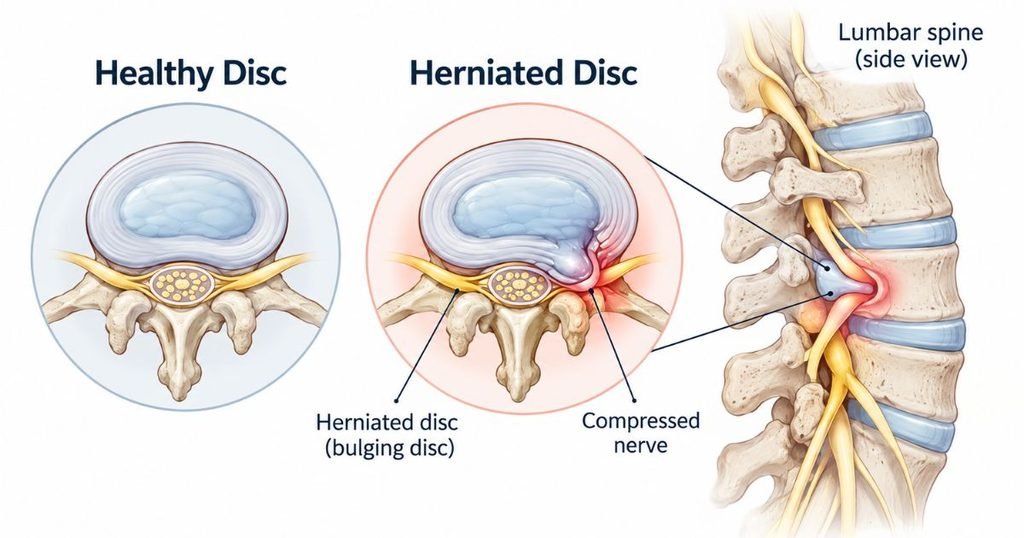
The discs between the vertebrae act as cushions and help the spine move. A herniated disc is a localized displacement of disc material beyond the normal margins of the intervertebral disc space.
A herniated disc does not always cause symptoms. However, when it irritates or compresses a nearby nerve, it can produce pain that travels from the back into the buttock, thigh or leg. Numbness, tingling or weakness may also occur depending on which nerve is affected.
In the lower back, nerve irritation from a herniated disc can produce symptoms commonly called sciatica.
What Is Spinal Stenosis?
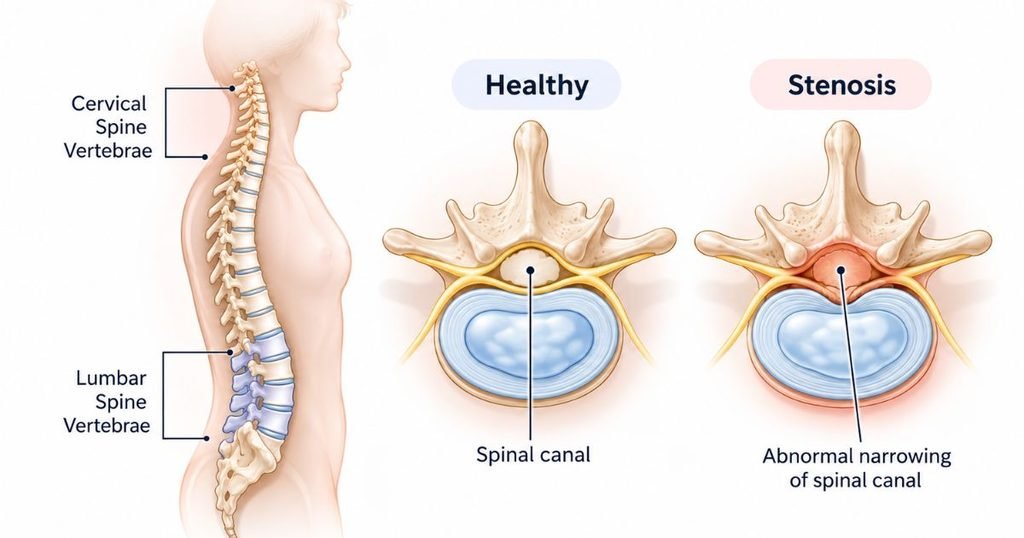
Spinal stenosis means narrowing within the spine. It can affect the central spinal canal or the openings through which individual nerve roots exit the spine.
Lumbar spinal stenosis affects the lower back and can cause back or leg symptoms. Some people develop neurogenic claudication, where leg pain, heaviness, numbness or weakness becomes more noticeable while standing or walking and may improve after sitting or changing position.
Cervical spinal stenosis affects the neck. If the narrowing compresses the spinal cord and causes spinal cord dysfunction, this is called cervical myelopathy. Symptoms can include hand clumsiness or loss of dexterity, arm or leg numbness or weakness, balance problems and difficulty walking.
Not everyone with spinal stenosis has symptoms, and an MRI finding does not automatically mean that stenosis is responsible for a person’s pain.
Can a Herniated Disc and Spinal Stenosis Occur Together?
Yes. This is an important distinction for patients to understand.
A person may have degenerative changes that have narrowed part of the spinal canal while also having a disc herniation. A disc abnormality can sometimes contribute to reduced space around a nerve, but a herniated disc and spinal stenosis remain different anatomical conditions.
This is why interpreting an MRI report in isolation can be misleading. The findings need to be considered alongside the patient’s symptoms and clinical examination.
How Are They Diagnosed?
Diagnosis usually starts with a detailed medical history and physical examination. A spine specialist may assess the location and pattern of pain, numbness or weakness, changes with walking or position, reflexes, muscle strength and sensation.
When imaging is clinically appropriate, MRI can provide detailed information about discs, nerve roots, the spinal canal and other soft tissues.
An MRI may show terms such as disc protrusion, disc extrusion, central canal stenosis or foraminal stenosis. These terms describe structural findings, but they do not necessarily explain every symptom a patient experiences.
For this reason, Dr. Rakesh Dhake, Spine Specialist at Zen Spine in Mumbai, considers the clinical findings along with relevant imaging when evaluating patients with spine-related symptoms.
How Are They Treated?
Treatment depends on the individual condition, symptoms, neurological findings and their effect on daily activities.
Many people with a symptomatic herniated disc can initially be managed with appropriate non-surgical treatment, provided there are no urgent neurological findings such as cauda equina syndrome or significant progressive weakness. Depending on the circumstances, this may include medication, activity modification and physiotherapy or rehabilitation.
Spinal stenosis can also be managed without surgery in appropriate patients. Treatment is based on the severity and pattern of symptoms and the patient’s overall clinical situation.
Surgery may be considered for selected patients when symptoms remain significant despite appropriate non-surgical treatment or when important neurological problems are present. A diagnosis of either condition does not automatically mean surgery is required.
When Should You See a Spine Specialist?
Persistent back pain, radiating leg or arm pain, numbness or tingling should be medically assessed when symptoms continue, worsen or interfere with normal activities. New or worsening muscle weakness should be assessed promptly.
Urgent medical assessment is particularly important if there is new difficulty starting urination, inability to pass urine or urinary retention, new loss of bladder or bowel control, numbness around the saddle/genital area, or rapidly progressive or severe leg weakness.
If you are looking for a spine specialist in Mumbai, Dr. Rakesh Dhake at Zen Spine can evaluate your symptoms and existing imaging and help determine whether further investigation or treatment is appropriate.
Herniated Disc vs Spinal Stenosis: What Should You Know?
A herniated disc is primarily a disc-related problem, while spinal stenosis refers to narrowing of a space within the spine. Both can cause nerve-related symptoms, and they can occur together.
If you have persistent back or leg symptoms, an MRI report alone should not be used to determine the cause. A proper clinical assessment helps connect the imaging findings with your symptoms and neurological examination.
Dr. Rakesh Dhake, Spine Specialist at Zen Spine, can assess your individual condition and discuss appropriate management based on your symptoms and clinical findings.
Frequently Asked Questions
Is a herniated disc the same as spinal stenosis?
No. A herniated disc involves displacement of disc material, while spinal stenosis involves narrowing of a space within the spine. Both can affect nerves and cause overlapping symptoms.
Can a herniated disc cause spinal stenosis?
A disc abnormality can contribute to narrowing around neural structures in some situations, but a herniated disc and spinal stenosis are not interchangeable terms.
Can spinal stenosis cause sciatica?
Lumbar spinal stenosis can cause radiating leg symptoms when nerve structures are affected. A clinical evaluation is needed to determine the underlying cause of leg pain.
Does every herniated disc need surgery?
No. Treatment depends on symptoms, neurological findings and the individual clinical situation. Many patients can initially be managed without surgery.
Does spinal stenosis always require surgery?
No. Some people with spinal stenosis have few or no symptoms. Surgery is considered only in selected circumstances based on the patient’s clinical findings and symptoms.