
Your MRI or X-ray report mentions spondylolisthesis, and you may wonder: Is it serious? Will it get worse? Do I need surgery?
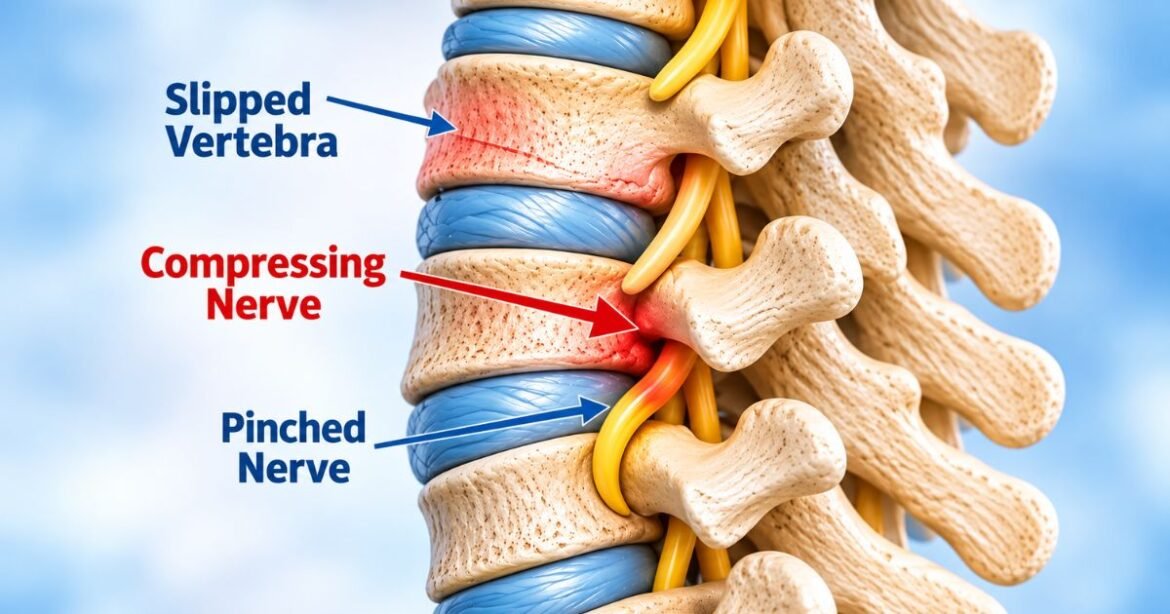
Spondylolisthesis occurs when one vertebra slips relative to the vertebra below it. It may cause back pain, sciatica or nerve-related symptoms, although some people have no discomfort.
At Zen Spine in Mumbai, Dr. Rakesh Dhake evaluates symptoms, examination findings and scans together to determine the most suitable treatment. Many patients improve without surgery.
What Happens When One Vertebra Slips Forward?
Imagine a stack of books where one book slides forward over another. Similarly, a vertebra can shift out of its normal alignment, most commonly at L4–L5 or L5–S1 in the lower back.
Forward slippage is called anterolisthesis. It may strain nearby discs and joints or narrow the space around spinal nerves.
However, a slipped vertebra does not always cause pain or require treatment.
What Causes Spondylolisthesis?
The cause depends on the type of spondylolisthesis:
- Degenerative: Age-related changes in spinal discs and joints gradually allow a vertebra to shift.
- Isthmic: A stress injury or defect in a small bony area called the pars interarticularis may contribute to slippage, sometimes associated with sports involving repeated backward bending.
- Other causes: Developmental abnormalities, injuries, weakened bones or previous spine surgery.
Identifying the cause helps guide treatment.
What Are the Symptoms of Spondylolisthesis?
Some patients experience no symptoms. Others may notice:
- Lower back pain or stiffness
- Buttock or leg pain
- Sciatica extending into the foot
- Numbness or tingling
- Leg weakness
- Discomfort during prolonged standing or walking
Symptoms depend on nerve involvement and surrounding spinal changes, not simply the amount of slippage.
Is Grade 1 Spondylolisthesis Serious?
Doctors use the Meyerding grading system to measure vertebral slippage.
| Grade | Amount of slippage |
| Grade 1 | Up to 25% |
| Grade 2 | More than 25–50% |
| Grade 3 | More than 50–75% |
| Grade 4 | More than 75–100% |
| Grade 5 | Complete displacement |
Grade 1 is a relatively small slip and often does not require surgery.
However, someone with Grade 1 may experience significant nerve pain, while another person with the same grade has no symptoms.
Treatment depends on symptoms and nerve compression, not the grade alone.
How Is Spondylolisthesis Diagnosed?
Diagnosis starts with a physical and neurological examination. Your doctor may recommend:
- X-rays: Show spinal alignment and the degree of slippage. Selected patients may need bending X-rays to assess movement.
- MRI: Identifies nerve compression, disc problems and spinal narrowing.
- CT scan: Provides detailed bone images, particularly when a pars defect is suspected.
Not every patient needs all three scans.
Can Spondylolisthesis Be Treated Without Surgery?
Yes. Many patients improve with conservative treatment, including:
- Physiotherapy: Exercises to strengthen supporting muscles and improve spinal stability.
- Activity modification: Temporarily avoiding movements that aggravate symptoms while staying comfortably active.
- Medications: Appropriate pain relief or anti-inflammatory medicines.
- Injections: Selected patients with nerve-related pain may benefit from epidural steroid injections.
These treatments aim to reduce pain, improve movement and restore daily function, rather than reposition the vertebra.
When Does Spondylolisthesis Require Surgery?
Surgery may be considered when symptoms remain disabling despite appropriate non-surgical treatment, neurological weakness progresses or significant nerve compression requires intervention.
Depending on the condition, surgical options include:
- Decompression: Creating space around compressed nerves.
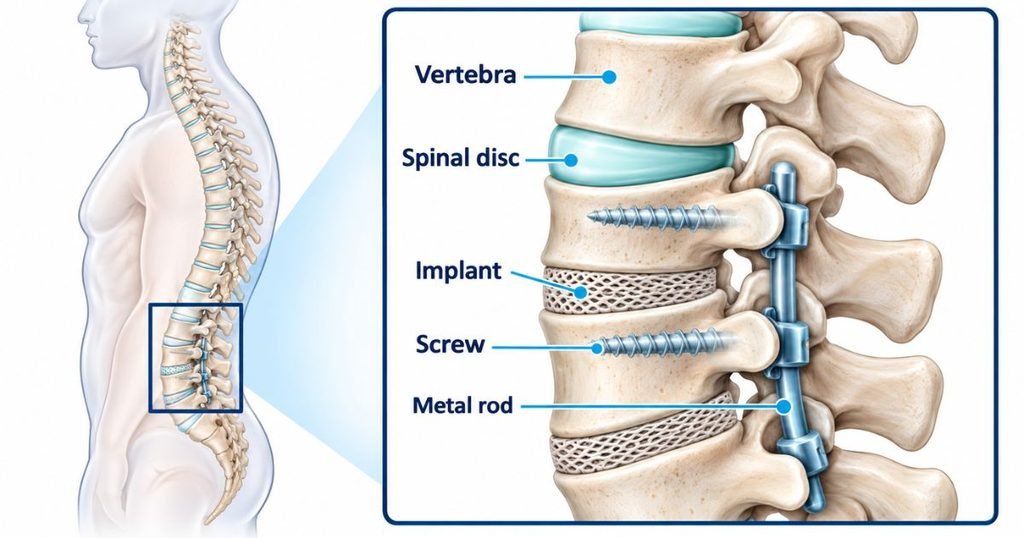
- Spinal fusion: Stabilising vertebrae when necessary.
- Pars repair: Repairing a suitable bony defect in selected patients.
Not everyone requires spinal fusion. The procedure depends on spinal stability, symptoms and imaging findings.
Can Spondylolisthesis Get Worse Over Time?
Spondylolisthesis can progress, but many people remain stable for years.
Progression depends on age, the underlying cause and spinal changes. New pain, increasing weakness or reduced walking ability should prompt reassessment.
Spondylolisthesis vs Spondylosis: What’s the Difference?
| Condition | Meaning |
| Spondylolisthesis | A vertebra shifts relative to another |
| Spondylosis | Age-related spinal degeneration |
| Herniated disc | Disc material pushes beyond its normal position |
| Spondylolysis | A defect or stress fracture in the pars |
These conditions are different but can occur together.
When Should You See a Spine Surgeon in Mumbai?
Consult a spine specialist if persistent back pain, sciatica, numbness or weakness affects daily life or fails to improve with initial treatment.
Seek emergency care for new bladder or bowel dysfunction, numbness around the genital area or rapidly worsening leg weakness.
Dr. Rakesh Dhake, Spine Surgeon at Zen Spine, also visits S. L. Raheja Fortis Hospital, Saifee Hospital, Wockhardt Hospitals and Bhatia Hospital in Mumbai.
Bring previous scans and reports to your consultation.
Book an appointment: Call +91 8668270346 or contact Zen Spine on WhatsApp.
Frequently Asked Questions
Q1. Can spondylolisthesis heal on its own?
Answer: The vertebra rarely returns to its original position naturally, but symptoms may improve without surgery.
Q2. Is walking good for spondylolisthesis?
Answer: Walking is suitable for many patients. Adjust distance and intensity according to symptoms and medical advice.
Q3. Which exercises should I avoid?
Answer: Heavy lifting and repeated backwards bending may aggravate certain cases. A physiotherapist can recommend suitable exercises.
Q4. Can you live a normal life with spondylolisthesis?
Answer: Yes. Many people maintain active lives with appropriate treatment and activity adjustments.
Q5. How long is recovery after surgery?
Answer: Recovery varies. Light activities may resume within weeks after some procedures, while spinal fusion generally requires several months of healing.