

Yes, can spine problems return after surgery? They can. A person may develop recurrent disc herniation at the previously treated level or a new spinal problem at another level. However, pain returning after surgery does not automatically mean that the original disc has herniated again. Finding the actual cause is important before considering further treatment.
Spine surgery treats a specific problem, but it does not stop the normal ageing and degenerative changes that can occur elsewhere in the spine. At Zen Spine in Mumbai, Dr. Rakesh Dhake focuses on evaluating the underlying cause of new or returning symptoms rather than assuming that every postoperative problem represents recurrence.
What Does “Problems Returning After Spine Surgery” Mean?
Can spine problems return after surgery? Yes, but “returning” can mean different things. A previously treated disc can herniate again, a different disc can become problematic, or degeneration can develop at a level next to a previously treated spinal segment.
Some patients may also experience persistent or recurrent pain because of nerve irritation, spinal degeneration, scar tissue or other postoperative changes. In some cases, the original structural problem has been adequately treated, but symptoms can still occur for another reason.
This is why new back or leg pain after surgery should not automatically be labelled as recurrent disc herniation.
What Is Recurrent Disc Herniation?
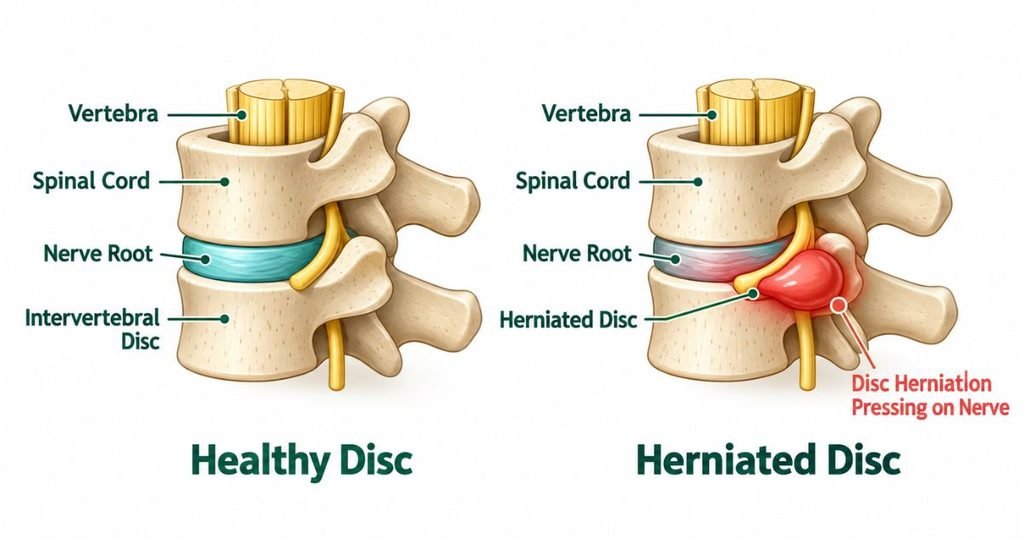
Recurrent disc herniation after surgery generally means that a disc herniates again at a previously operated level after the patient has experienced a period of improvement.
For example, a person who underwent lumbar discectomy for a herniated disc may initially improve and later develop similar leg pain because disc material has herniated again at the same level.
What Are Recurrent Disc Herniation Symptoms?
The recurrent disc herniation symptoms can resemble those experienced before the original operation. Depending on the location of the affected disc and nerve, symptoms may include:
- Back pain
- Pain travelling into the buttock or leg
- Numbness or tingling
- Weakness in the affected limb
- Sciatica or other nerve-related symptoms
Symptoms alone cannot confirm recurrent herniation. A clinical and neurological examination, together with appropriate imaging when required, helps determine what is happening.
How Common Is Recurrent Disc Herniation?
Recurrent disc herniation is a recognized complication after lumbar discectomy. Published research reports different recurrence rates, partly because studies use different definitions of recurrence and follow patients for different lengths of time.
Reviews of the available evidence commonly report recurrence rates in the approximately 5%–15% range, although reported figures vary between studies and patient groups. A frequently cited evidence review from the WFNS Spine Committee on recurrent lumbar disc herniation highlights this variability.
A recurrence rate should therefore not be presented as a guarantee of what will happen to an individual patient. Personal risk can depend on factors related to the original disc problem, patient characteristics and other clinical factors.
What Is Adjacent Segment Disease?
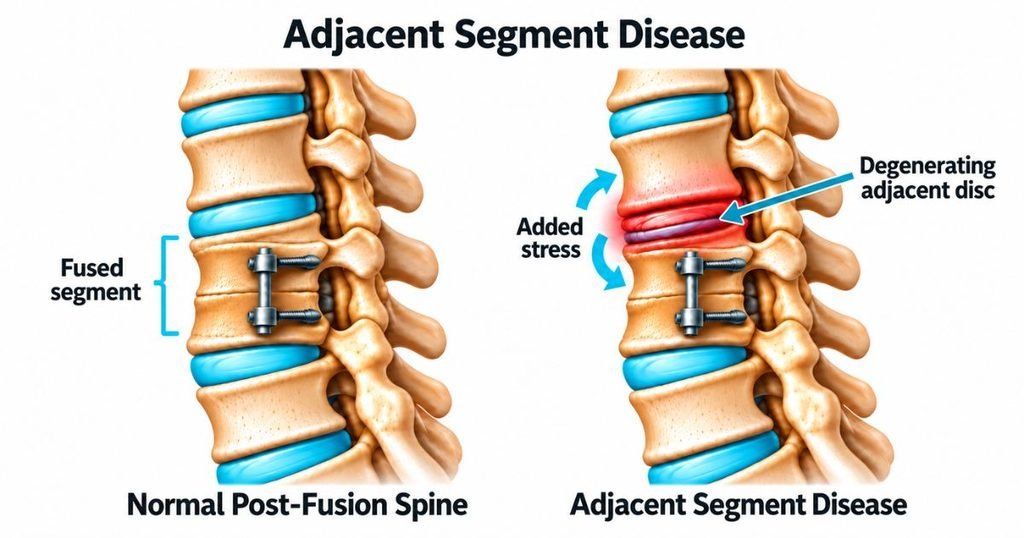
Adjacent segment disease describes a symptomatic problem developing at a spinal level next to a previously treated spinal segment. It is particularly discussed after spinal fusion because the operated segment has been stabilized while the neighbouring levels continue to move.
It is important to distinguish adjacent segment degeneration from adjacent segment disease. Degenerative changes seen on an X-ray or MRI do not necessarily mean that a patient has symptoms or requires treatment.
Spinal degeneration can also occur naturally with ageing. Therefore, a new problem at a neighbouring level should not automatically be described as being caused by previous surgery.
Recurrent Herniation vs Adjacent-Level Problems
| Feature | Recurrent disc herniation | Adjacent-level problem |
| Location | Previously treated spinal level | Level next to a treated segment |
| Main issue | Disc herniates again | Degeneration or another spinal condition develops |
| Symptoms | Back or radiating nerve pain may recur | Symptoms depend on the affected level |
| Diagnosis | Examination and appropriate imaging | Examination and imaging when indicated |
| Treatment | Depends on symptoms and findings | Depends on the specific condition |
This distinction is important because recurrent disc herniation after surgery and an adjacent-level problem are not the same diagnosis.
What Are the Risk Factors?
Several factors have been associated with recurrent lumbar disc herniation, although the risk varies between patients. Research has identified factors such as smoking, higher body weight, diabetes and characteristics of the original disc herniation. Some studies have also examined the size of the annular defect in the disc.
Recovery after surgery also matters. Patients should follow their surgeon’s advice regarding rehabilitation, lifting and gradual return to physical activity. There is no single exercise or activity schedule that is appropriate for every type of spine surgery.
Stopping tobacco use, maintaining a healthy weight and following an appropriate rehabilitation program can support overall spinal health, although they cannot completely eliminate the possibility of future spine problems.
What Causes Back Pain to Return After Spine Surgery?
Back pain returning after spine surgery can have several explanations. Recurrent disc herniation is one possibility, but it is not the only one.
Other possibilities may include:
- Degenerative changes in the spine
- A new disc problem at another level
- Spinal stenosis or nerve compression
- Postoperative changes
- Persistent nerve-related symptoms
- A different musculoskeletal source of pain
The term failed back surgery syndrome has historically been used to describe persistent or recurrent pain after spinal surgery. It is a broad term rather than a single disease, and identifying the underlying cause is more useful than assuming that the previous surgery has simply “failed.”
How Are Recurrent Spine Problems Diagnosed?
The evaluation generally begins with the patient’s history and a physical and neurological examination. The doctor may want to know when the original symptoms improved, when the new symptoms started, whether they are similar to the original symptoms and whether there has been new numbness or weakness.
MRI can provide useful information about discs, nerves and other spinal structures when it is clinically indicated. X-rays may also be useful in selected patients, particularly when evaluating spinal alignment or changes following fusion.
Previous scans can be particularly helpful because they allow the doctor to compare the spine before and after surgery.
Importantly, an abnormal MRI does not automatically mean that the abnormality is responsible for the patient’s symptoms. Imaging findings need to be considered together with the patient’s symptoms and examination.
What Are the Treatment Options?
Treatment depends on the actual cause, severity of symptoms, neurological findings and the patient’s overall clinical situation.
Some patients may improve with non-surgical treatment, which can include appropriate medication, physiotherapy, activity modification and, in selected cases, injections.
If recurrent disc herniation is confirmed and symptoms are significant or neurological problems are present, further surgery may sometimes be considered. Depending on the individual situation, this could include repeat discectomy, endoscopic or minimally invasive procedures, or revision fusion.
Not every patient with recurrent pain needs another operation. The objective is to identify the underlying problem first and then select treatment accordingly.
How Long Does a Disc Surgery Last?
The question how long does a disc surgery last can refer either to the duration of the operation or how long its benefits continue.
The actual operating time varies according to the procedure, spinal level, surgical technique and individual patient factors. The long-term benefit also varies. Surgery treats the specific condition for which it was performed, but it cannot prevent all future degenerative changes or new problems elsewhere in the spine.
When Should You See a Spine Surgeon?
New or worsening neurological symptoms should be assessed promptly. Urgent medical attention is important if there is new loss of bladder or bowel control, numbness around the saddle or genital region, or significant or rapidly worsening weakness.
For persistent or recurrent symptoms that are not emergencies, an evaluation by a spine surgeon in Mumbai can help determine whether the problem is recurrent disc herniation, an adjacent-level condition or another cause.
At Zen Spine, Dr. Rakesh Dhake, Spine Specialist in Mumbai, evaluates spine conditions based on the patient’s symptoms, examination and appropriate investigations rather than relying on imaging alone.
Patients attending a consultation can bring previous MRI or CT scans, operative records if available, current reports, medication details and a timeline of when their symptoms returned.
Frequently Asked Questions
Q1. What are the symptoms of recurrent disc herniation?
Answer: Recurrent disc herniation symptoms can include back pain, radiating leg pain, sciatica, numbness, tingling or weakness. They may resemble the symptoms experienced before the original surgery, but symptoms alone cannot establish the diagnosis.
Q2. Can spine problems return years after surgery?
Answer: Yes. A recurrent disc problem or a new condition at another spinal level can develop months or years after surgery. Natural spinal degeneration can also continue over time. The timing of symptoms alone cannot determine their cause.
Q3. Does recurrent disc herniation always require another surgery?
Answer: No. Treatment depends on the symptoms, neurological examination, imaging findings and response to non-surgical treatment. Some patients can be managed without another operation, while others may require revision surgery when clinically appropriate.
Q4. What is adjacent segment disease?
Answer: Adjacent segment disease refers to a symptomatic problem developing at a spinal level next to a previously treated segment. It should be distinguished from adjacent segment degeneration, which may describe imaging changes without significant symptoms.
Q5. Is back pain after surgery always a sign that the surgery failed?
Answer: No. Back pain returning after spine surgery can have several causes, including recurrent disc herniation, degeneration, a new spinal problem or postoperative changes. A proper evaluation is needed before concluding that the original surgery was unsuccessful.
Q6. Can another disc become affected after spine surgery?
Answer: Yes. A disc at another spinal level can develop degeneration or herniation. This is different from recurrent herniation at the previously operated level.