
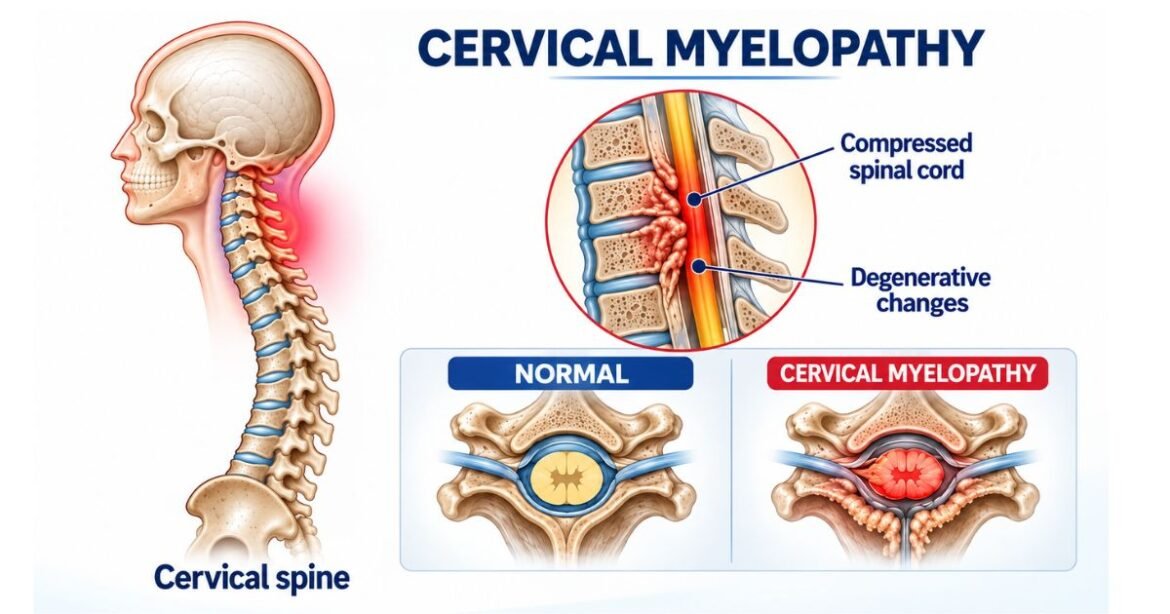
Cervical myelopathy occurs when the spinal cord becomes compressed in the neck. Unlike ordinary neck pain, it can affect the way your hands work, how you walk, your balance, and your coordination.
The condition often develops gradually, which means early symptoms can be easy to overlook. Difficulty with buttons, dropping objects, numbness in the hands, or feeling increasingly unsteady while walking may be early signs that need medical assessment.
Understanding Cervical Myelopathy
Cervical myelopathy is caused by compression of the spinal cord within the cervical spine, which is the part of the spine in the neck.
The spinal cord carries signals between the brain and the rest of the body. When it becomes compressed, those signals can be disrupted. As a result, cervical myelopathy can cause symptoms in the hands, arms, legs and feet, rather than causing neck symptoms alone.
This is an important difference between cervical myelopathy and many common causes of neck pain.
Neck pain and stiffness can occur, but some people with cervical myelopathy have only mild neck discomfort or no neck pain at all.
Recognising the Symptoms of Cervical Myelopathy
Cervical myelopathy symptoms often develop gradually. A person may initially notice small changes in everyday activities before realising that they could be related to a spinal problem.
| Symptom | What you may notice in daily life |
| Hand clumsiness | Difficulty buttoning clothes, writing, tying shoelaces or handling small objects |
| Numbness or tingling | Pins and needles or reduced sensation in the hands, arms, feet or legs |
| Balance problems | Feeling unsteady, frequent tripping or difficulty walking confidently |
| Limb weakness | Arms or legs may feel weak, heavy or less coordinated |
| Neck pain or stiffness | Discomfort or reduced movement in the neck, although pain may be mild or absent |
| Bladder or bowel changes | Urgency or loss of control can occur in more severe cases and requires medical attention |
One of the more noticeable symptoms can be loss of hand dexterity. You may find yourself dropping objects more frequently, struggling with a shirt button, or finding handwriting more difficult than it used to be.
Balance and gait changes are another important warning sign. Walking may become stiff, clumsy or unsteady, and some people may start tripping more often.
When Should You Get Your Symptoms Assessed?
Progressive weakness, worsening hand coordination, increasing numbness, difficulty walking, or new balance problems should not simply be attributed to aging.
These symptoms do not necessarily mean that you have cervical myelopathy, but when they persist or worsen, a clinical assessment can help identify the cause.
What Causes Cervical Myelopathy?
The most common cause of cervical myelopathy is age related degeneration of the cervical spine.
Over time, changes in the discs, joints and ligaments can reduce the space available for the spinal cord. A disc may also bulge or herniate and contribute to compression.
Common causes include:
- Cervical spondylosis and degenerative changes
- Disc degeneration or cervical disc herniation
- Narrowing of the spinal canal
- Thickening of spinal ligaments
- Less commonly, trauma or other conditions affecting the cervical spine
A common misconception is that cervical myelopathy is simply harmless neck pain or a normal part of getting older.
The confusion is understandable because some people experience very little neck pain. However, the important issue is whether the spinal cord is being compressed and whether this is producing neurological symptoms.
How Is Cervical Myelopathy Diagnosed?
Diagnosis begins with a detailed discussion of your symptoms and a neurological examination.
A spine specialist may assess:
- Muscle strength
- Sensation
- Reflexes
- Hand coordination
- Balance
- Walking pattern
- Other neurological signs
An MRI of the cervical spine is particularly useful because it can show the spinal cord, discs, spinal canal and areas where compression may be occurring.
X-rays or CT scans may also be recommended in selected cases.
It is important to understand that cord compression on MRI should be interpreted alongside symptoms and neurological examination because imaging severity and clinical disability do not always correspond closely.
Cervical Myelopathy Treatment Options
There is no single treatment that is appropriate for everyone with cervical myelopathy.
The right approach depends on factors such as the severity of symptoms, neurological findings, the degree of spinal cord compression, and whether the condition is stable or progressing.
Non-Surgical Treatment
Depending on the individual case, treatment may include medication, appropriate activity modification and physiotherapy.
These approaches may have a role in selected patients, particularly when symptoms are mild or when the diagnosis and progression need to be monitored.
However, patients should understand an important limitation: nonsurgical treatment does not physically remove compression from the spinal cord.
For this reason, cervical myelopathy should not be treated in exactly the same way as uncomplicated neck pain.
When Is Surgery Considered?
Surgery may be recommended when there is significant spinal cord compression, progressive neurological deterioration, or clinical evidence that decompression is appropriate.
The primary goal of cervical myelopathy surgery is to relieve pressure on the spinal cord and prevent further neurological deterioration.
The amount of recovery after treatment varies from person to person. Factors such as the severity and duration of symptoms and the condition of the spinal cord can influence the outcome. Rehabilitation may then focus on remaining limitations in walking, balance, strength, endurance, and everyday function.
This is why a treatment decision should be based on an individual assessment rather than an MRI report alone.
Can Cervical Myelopathy Get Worse Without Treatment?
Cervical myelopathy can progress over time, although the speed and pattern of progression differ between individuals.
If symptoms such as hand clumsiness, weakness, numbness, balance problems, or difficulty walking are becoming worse, it is important to seek appropriate medical advice.
The reason is simple: prolonged or worsening spinal cord compression can result in neurological problems that may become more difficult to reverse.
Early assessment does not necessarily mean that you will need surgery. It means understanding what is causing your symptoms and making an informed decision about the appropriate treatment. However, progressive neurological symptoms should not be delayed while trying repeated courses of routine neck physiotherapy.
Choosing the Right Treatment for Cervical Myelopathy
Patients often search online for the best cervical myelopathy treatment in Mumbai, but there is no single treatment that can be called the best for every patient.
The appropriate treatment depends on the individual’s symptoms, examination findings, imaging and overall health.
A specialist assessment can help answer more useful questions:
- Is the spinal cord actually being compressed?
- Are my symptoms related to that compression?
- Is the condition stable or progressing?
- Would observation or non surgical treatment be appropriate?
- Would spinal cord decompression provide a potential benefit?
At Zen Spine, the focus is on understanding these factors before recommending a treatment approach. Dr Rakesh Dhake assesses the clinical picture rather than relying on imaging findings alone, with the aim of helping patients understand their condition and make an informed decision about treatment.
Making Sense of Cervical Myelopathy
Cervical myelopathy is more than ordinary neck pain. Changes in hand function, balance, walking, sensation, or limb strength can indicate that the spinal cord is being affected.
The condition can sometimes develop so gradually that the symptoms are mistaken for aging or everyday stiffness. Paying attention to changes in coordination and neurological function is therefore important.
If you are experiencing symptoms that could be related to cervical myelopathy, an appropriate clinical assessment and cervical spine imaging can help determine what is happening and whether treatment is necessary.
Frequently Asked Questions
Is cervical myelopathy serious?
Cervical myelopathy can be a significant spinal condition because it involves the spinal cord. Its severity depends on the degree of compression, neurological symptoms, and whether the condition is progressing.
Can cervical myelopathy occur without neck pain?
Yes. Some people have little or no neck pain. Changes in hand coordination, walking, balance, sensation, or limb strength may be more noticeable.
Can cervical myelopathy be treated without surgery?
Some patients may be managed without surgery depending on their symptoms and clinical findings. However, nonsurgical measures do not directly remove spinal cord compression, so treatment needs to be individualised.
Can cervical myelopathy cause difficulty walking?
Yes. Spinal cord compression in the neck can affect coordination and the signals controlling the legs, potentially resulting in balance problems, stiffness, unsteadiness, or difficulty walking.
When should I see a spine surgeon?
Persistent or worsening hand clumsiness, weakness, numbness, balance problems or changes in walking should be assessed by an appropriate medical professional. Earlier evaluation can help determine the cause and available treatment options.