Recurrent sciatica after slip disc surgery does not always mean the disc has herniated again. Returning leg pain can result from recurrent disc herniation, postoperative scar tissue, persistent nerve irritation, or other spinal conditions. The timing of pain, symptoms and MRI findings helps determine the actual cause.
If your leg pain has returned after slip disc surgery, understanding why it has happened is the first step towards choosing the right treatment.
Why Does Slip Disc Pain Return After Surgery?
There are several reasons why patients may experience slip disc pain after surgery again.
1. Recurrent Disc Herniation
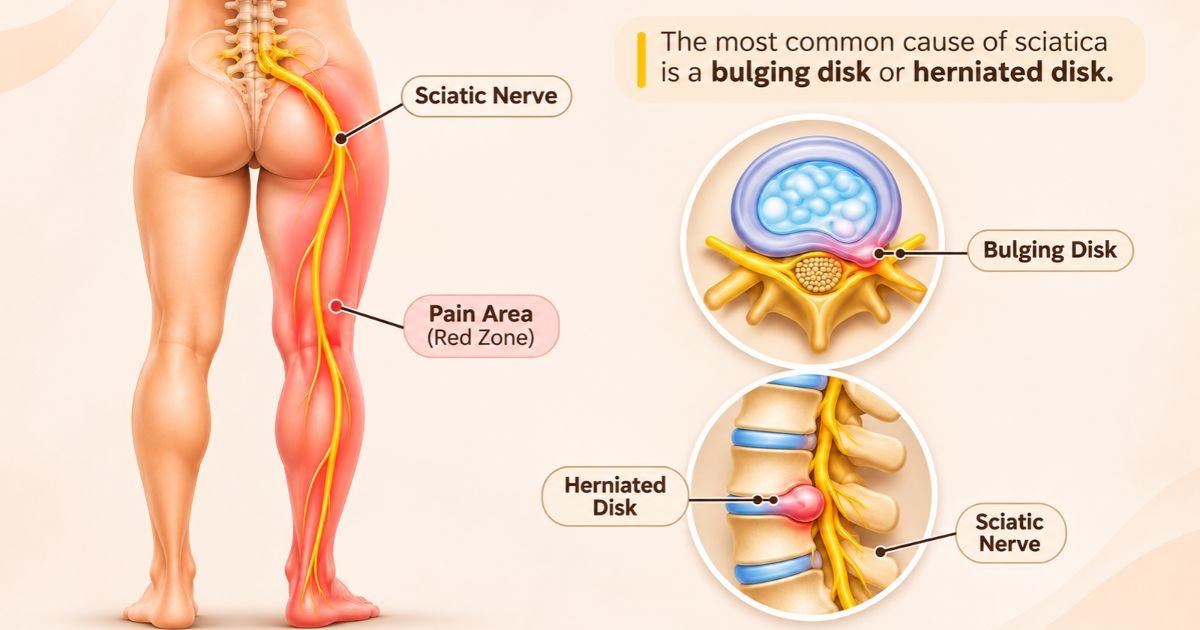
Recurrent disc herniation occurs when disc material herniates again at the previously operated level, potentially compressing a nearby nerve. It can produce symptoms similar to the original condition, including shooting leg pain, numbness, tingling, and lower back discomfort.
2. Scar Tissue Formation
After surgery, the body naturally forms scar tissue around the operated area. In some patients, extensive epidural fibrosis may contribute to persistent nerve-related pain.
3. Persistent Nerve Irritation
Even after pressure on a nerve has been relieved, the nerve may take time to recover. Some patients continue experiencing pain, tingling or numbness during recovery without having another disc herniation.
4. Other Spinal Conditions
Conditions such as spinal stenosis, foraminal narrowing or degeneration of another disc can also contribute to recurring leg pain.
How Long After Surgery Can a Disc Slip Again?
The timing of returning pain is an important clue when evaluating recurrent sciatica. Not every episode of leg pain after surgery represents a new disc herniation.
| Timeline | What it may indicate |
| First few days or weeks | Postoperative healing, residual nerve irritation or persistent symptoms |
| After initial improvement | May indicate residual or recurrent nerve irritation, recurrent disc herniation or another spinal condition |
| After a prolonged pain-free period | Recurrent disc herniation becomes an important possibility. |
Recurrent lumbar disc herniation is commonly defined as a new herniation at the previously operated level following a pain-free interval, often defined as at least six months. However, definitions vary across studies.
What Does the Pattern of Returning Pain Tell You?
Certain symptom patterns may provide useful clues:
- Sharp shooting leg pain after a pain-free period: May raise suspicion of recurrent nerve compression.
- Pain that progressively worsens: Needs medical evaluation to identify whether nerve compression or another condition is responsible.
- Pain aggravated by coughing, sneezing or straining: May occur with lumbar disc herniation or nerve root irritation, but is not specific to recurrent disc herniation.
- New or worsening numbness or leg weakness: May indicate nerve involvement and requires prompt medical assessment.
These patterns are clues, not a diagnosis. A clinical examination and appropriate imaging are needed to establish the cause.
Does Recurrent Sciatica Always Mean the Disc Has Slipped Again?
No. Recurrent sciatica does not automatically mean that the original slipped disc has returned.
An MRI may show disc abnormalities even in people who have no symptoms. Similarly, scar tissue, nerve irritation and other spinal conditions can produce pain without a new disc herniation.
MRI findings must therefore be interpreted alongside the patient’s symptoms and clinical examination. The presence of a disc bulge alone does not establish the cause of leg pain.
When Should You Worry About Leg Pain After Slip Disc Surgery?
Some residual leg pain, tingling or numbness may persist during nerve recovery after surgery. However, worsening or returning leg pain should not be ignored.
Consult your spine specialist if you experience:
- Increasing or recurring shooting pain in the leg.
- New numbness or tingling.
- Weakness in your foot or leg.
- Difficulty walking or performing everyday activities.
- Pain that returns after a period of significant relief.
Important warning signs: New bladder or bowel dysfunction, numbness around the groin or saddle area, or rapidly worsening leg weakness require immediate emergency medical assessment. These symptoms may indicate serious nerve compression, including cauda equina syndrome.
How Is Recurrent Sciatica Diagnosed After Surgery?
A spine specialist generally begins with a detailed medical history and neurological examination to assess muscle strength, reflexes, sensation and the pattern of leg pain.
MRI may help identify recurrent disc herniation, nerve compression and postoperative changes. Contrast-enhanced MRI may be useful in selected cases to distinguish recurrent disc material from postoperative scar tissue.
Under the guidance of Dr. Rakesh Dhake at Zen Spine, the evaluation focuses on correlating the patient’s symptoms, neurological examination, and MRI findings before deciding on an appropriate treatment plan.
Previous MRI scans, operation records, and discharge summaries can also help establish what has changed since surgery.
Does Recurrent Disc Herniation Always Require Another Surgery?
No. Repeat surgery is not necessary for every patient experiencing recurrent sciatica.
Depending on the underlying cause and severity of symptoms, treatment may include medication, guided physiotherapy, activity modification, or selected injection-based treatments.
Revision disc surgery may be considered for confirmed recurrent herniation causing persistent disabling symptoms despite appropriate non-surgical treatment or significant or progressive neurological weakness.
The decision should be based on clinical findings, imaging and an individual assessment rather than the MRI report alone.
When Should You See a Spine Specialist?
If you experience recurring leg pain after slip disc surgery, a specialist evaluation can help identify whether the symptoms are related to recurrent disc herniation, scar tissue, persistent nerve irritation, or another spinal condition.
At Zen Spine, Dr. Rakesh Dhake can evaluate your symptoms, review previous MRI scans and surgical records, assess neurological function, and discuss appropriate treatment options.
The objective is to identify the actual cause of recurrent sciatica and determine whether medication, rehabilitation, or further intervention is appropriate. Not every patient with returning leg pain needs another operation.
What Should You Bring to Your Spine Consultation?
Carry your previous MRI scans and reports, operation notes, discharge summary, current medication list, and details of when your leg pain returned. Information about numbness, weakness, and previous physiotherapy can also help with the assessment.
Frequently Asked Questions
Q1. Is leg pain a few weeks after slip disc surgery normal?
Answer: Some leg discomfort, tingling, or residual nerve pain can occur during recovery. However, worsening symptoms, new weakness, or increasing numbness should be assessed by your treating specialist.
Q2. Can a slipped disc return at a different spinal level?
Answer: Yes. A different spinal level can develop a new disc herniation, causing symptoms similar to the original problem. This is a new herniation, not a recurrence at the previously operated level. Clinical examination and appropriate imaging help identify the affected level.
Q3. Can physiotherapy help with sciatica after disc surgery?
Answer: Physiotherapy may help improve mobility, strength, and recovery in suitable patients. The exercises and timing should be guided by the treating specialist according to the surgery performed and the patient’s condition.
Q4. Can scar tissue after back surgery be treated?
Answer: Treatment depends on whether scar tissue is actually responsible for the symptoms. Medication, rehabilitation, and selected interventions may be considered following specialist evaluation.
Q5. Can I avoid another operation if my disc has slipped again?
Answer: In some cases, yes. Non-surgical treatment may be appropriate depending on pain severity, neurological findings, and the degree of nerve compression. Surgery is considered when clinically indicated.
Q6. What should I ask my spine specialist about recurrent sciatica?
Answer: Ask about the likely cause of returning pain, whether an MRI is needed, whether the operated disc has herniated again, and what non-surgical and surgical treatment options are available.