
Being told that you have a slipped disc can be worrying, particularly when an MRI report contains terms such as disc herniation, nerve compression or disc protrusion. But an MRI finding does not automatically mean that you need surgery.
So, when does a slipped disc require surgery?
According to Dr. Rakesh Dhake, a spine surgeon in Mumbai, for many patients, surgery is not the first treatment. The decision depends on your symptoms, neurological examination, MRI findings and how you respond to appropriate non surgical treatment.
At Zen Spine, the aim is to help patients understand their condition and choose the treatment that is appropriate for them, rather than assuming that every herniated disc needs an operation.
Does Every Slipped Disc Need Surgery?
No. Many people with a slipped disc can be managed without surgery, particularly when symptoms are mild or improving.
Depending on the individual case, treatment may include medication, activity modification, physiotherapy, and other non-surgical measures. When there are no emergency symptoms or significant or progressive neurological deficits, an initial period of appropriate non-surgical treatment may be recommended. The duration varies depending on symptom severity, neurological findings, and how the patient responds to treatment.
The important point is that treatment should be guided by your symptoms and clinical examination, not by the MRI report alone.
A disc problem seen on an MRI may not always be responsible for the pain you are experiencing.
When Does a Slipped Disc Require Surgery?
Surgery may be considered when a slipped or herniated disc is causing significant nerve-related problems or when symptoms have not improved despite appropriate conservative treatment.
Progressive or significant weakness
Weakness in the leg, foot, or other affected muscles can indicate that a nerve is being compressed. If neurological weakness is significant or progressively worsening, prompt specialist assessment is important, and surgery may be recommended if nerve compression is identified as the cause.
This is different from pain alone and requires proper clinical assessment.
Persistent, disabling pain despite treatment
Severe pain from a slipped disc can sometimes continue despite medication, physiotherapy, and other appropriate non-surgical treatment.
If pain remains persistent and significantly interferes with walking, sleeping, working, or normal daily activities after an appropriate period of treatment, surgery may become a reasonable option.
Significant nerve compression
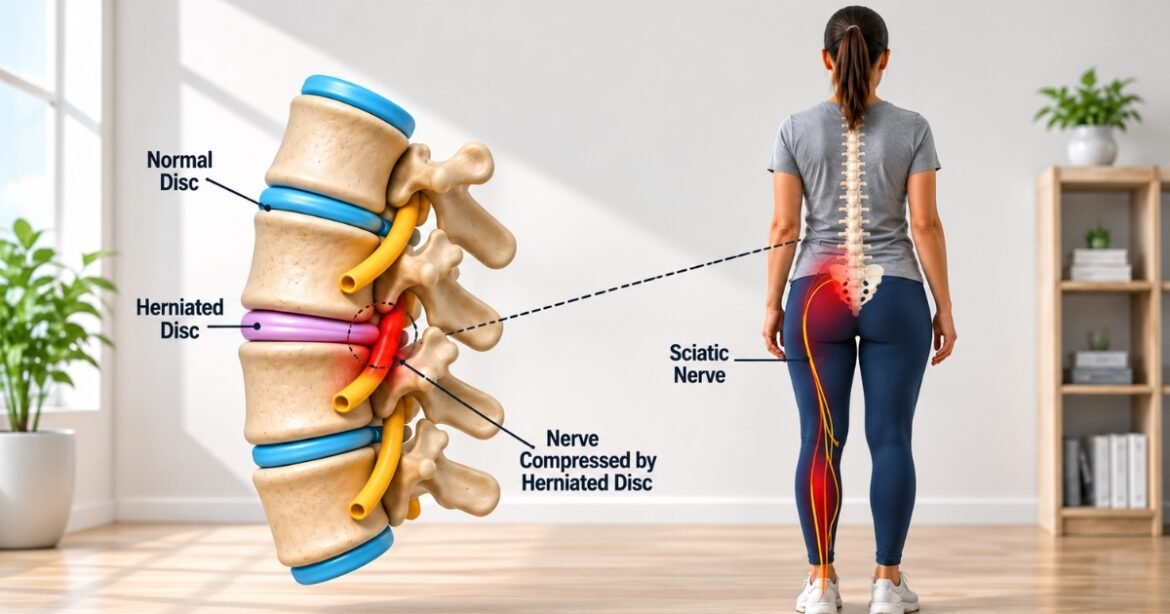
A herniated disc can press against a spinal nerve and cause symptoms such as sciatica, leg pain, numbness, or weakness. Surgery may be considered when clinically important symptoms or neurological findings correspond with nerve compression seen on imaging, particularly when symptoms are persistent, disabling, or worsening despite appropriate treatment.
Emergency neurological symptoms
Some symptoms require urgent medical assessment rather than waiting for conservative treatment to work.
New bladder or bowel problems, numbness around the inner thighs or genital area, or severe and rapidly worsening neurological weakness can be warning signs of serious nerve compression.
If these symptoms occur, go to the nearest emergency department immediately rather than waiting for a routine clinic appointment.
When Can a Slipped Disc Be Treated Without Surgery?
If there is no emergency neurological problem and symptoms are manageable or improving, nonsurgical treatment may be appropriate.
Treatment can include:
- Medication prescribed according to your condition
- Physiotherapy and guided rehabilitation
- Appropriate activity modification
- Other nonsurgical treatments based on your symptoms and examination
The goal is to control symptoms, improve function and allow the body an opportunity to recover without an operation when surgery is not necessary.
This is why a diagnosis of “slip disc” should not immediately be viewed as a diagnosis that requires surgery.
Does an MRI Mean You Need Slipped Disc Surgery?
Not necessarily.
An MRI is an important diagnostic tool, but its findings need to be interpreted alongside the patient’s symptoms and clinical examination.
For example, an MRI may show a disc bulge or herniation in someone who has little or no significant symptoms. Conversely, a patient with severe leg pain or neurological weakness may have imaging that shows nerve compression corresponding to their symptoms.
The decision about slipped disc surgery should therefore consider:
- Your symptoms and their severity
- Neurological examination findings
- Duration of symptoms
- Response to nonsurgical treatment
- MRI findings and their clinical relevance
A lengthy or complicated MRI report does not automatically mean that your condition is severe. Dr. Dhake advises patients not to panic simply because their scan contains unfamiliar medical terminology.
What If Surgery Is Recommended?
When surgery is appropriate, the objective is generally to relieve pressure on the affected nerve and address the disc problem responsible for the symptoms.
The exact procedure depends on factors such as the location and nature of the disc herniation and the patient’s clinical condition.
Dr. Rakesh Dhake performs minimally invasive spine procedures, including endoscopic, microscopic and tubular techniques where appropriate. These approaches are designed to access the affected area through smaller surgical corridors while aiming to minimise unnecessary tissue disruption.
However, the suitability of a particular technique depends on the individual patient. A minimally invasive approach is not automatically the right procedure for every slipped disc.
When Should You See a Spine Surgeon for a Slipped Disc?
You should consider a specialist assessment if your back or leg pain is persistent, symptoms are affecting your daily activities, you develop numbness or weakness, or your symptoms are getting worse.
A spine surgeon can assess whether your symptoms are likely to improve with continued nonsurgical treatment or whether surgery should be considered.
For patients in Mumbai, Dr. Rakesh Dhake provides spine consultations at Zen Spine, with clinics in Dadar and Malad. He also consults and operates at Saifee Hospital, Wockhardt Hospital, and SL Raheja Fortis Hospital, Mahim.
Making the Right Decision About Slipped Disc Surgery
A slipped disc diagnosis does not automatically mean that you need an operation. In many cases, treatment can begin without surgery. However, persistent disabling symptoms, significant or progressive neurological weakness, significant nerve compression, or emergency neurological symptoms may change the treatment decision.
The most important step is to have your symptoms and MRI assessed together by an experienced spine specialist.
Dr. Rakesh Dhake is an orthopedic spine surgeon in Mumbai with advanced spine training in India and overseas. His qualifications include an MBBS from Seth G.S. Medical College and KEM Hospital, Mumbai, an MS in Orthopaedics from Lokmanya Tilak Municipal Medical College and LTMGH, Mumbai, and advanced spine fellowship training in India and overseas.
At Zen Spine, the focus is on personalized, evidence-based spine care and helping patients make informed decisions about their treatment.
Frequently Asked Questions
Q1. Can a slipped disc heal without surgery?
Answer: Yes, surgery is not required for every slipped disc. When there are no emergency neurological signs, appropriate nonsurgical treatment may be tried first. Dr. Dhake typically considers a period of around 6 to 12 weeks of conservative treatment before considering surgery, depending on the individual case.
Q2. Does severe sciatica always require surgery?
Answer: No. Severe sciatica does not automatically mean that surgery is necessary. The decision depends on factors such as the severity and duration of symptoms, neurological findings, imaging and response to treatment.
Q3. Can an MRI tell me whether I need surgery?
Answer: An MRI can show disc herniation and nerve compression, but it cannot by itself determine whether surgery is necessary. The scan needs to be correlated with your symptoms and clinical examination.
Q4. When is a slipped disc an emergency?
Answer: Symptoms such as new bladder or bowel dysfunction, numbness around the saddle area or severe and rapidly progressing neurological weakness require urgent medical assessment.
Q5. Is slipped disc surgery always minimally invasive?
Answer: Not necessarily. The appropriate surgical approach depends on the patient’s condition, the location of the disc problem, and other clinical factors. Minimally invasive techniques such as endoscopic, microscopic, or tubular procedures may be suitable in selected cases.